Reprinted from my active learner blog Catalogue:
The end of the semester is quickly approaching. The students enrolled my "The Nineteenth Century City" course have completed the work for our December 2 presentation. There, we will present our research on young women and education in early Alabama and an urbanizing America. Between the 1830s and 1920, cities increasingly grew in the United States owing partly to the invention of the steamboat and railroads, two technologies that helped people move through space more easily. Historian Gunther Barth has argued that within this period an urban “culture” emerged via the arrival of apartment houses, department stores, baseball, vaudeville houses, and metropolitan newspapers. In such things, as he writes, people with very different racial and ethnic backgrounds managed to find a “common humanity” and learned how to cope in congested spaces. Notably, Barth did not look to churches or institutions of higher learning for signs of an urbanizing America. This was possibly because in those two spaces he saw more homogeneous populations, or people whose backgrounds were similar. The students in this course were charged with looking for signs of an urban culture in the lives of young women who attended college during the nineteenth century or at the turn of the century, in and outside of Alabama. Certainly a female academy existed in Tuscaloosa even before the University of Alabama opened in Tuscaloosa in 1831. Some such students include Addie Lovett Findlay whose diploma is pictured here, and the coeds who lived with the family of a Bryce Hospital administrator. They are also pictured. As this exhibit hopes to demonstrate, young women in a city that still feels like a college town even today were becoming sophisticated people in the years surrounding the Civil War. The students studied several documents to learn more about such women and others in West and North Alabama. Among the documents was an 1861 letter from a Huntsville, Alabama, girl of mixed race who attended Wilberforce after being recently manumitted. Ultimately, the class saw how historians interpret the past while often relying on very little information. The result was four displays that will be presented on 4-5:30 pm at the university's Gorgas House. Use this interactive map for directions. There will also be a silent auction of photography inspired by the nineteenth century city theme taken and curated by the students. We are pleased to have Birmingham Southern University Associate Professor of History Victoria Ott as our guest speaker. Her talk is titled "A Safe Place to Hide?: The Role of Female Academies in the Confederate South."
This event is co-sponsored by the Summersell Center for the Study of the South.
This past Wednesday, the students visited Smith Hall, home of the Alabama's Museum of Natural History. There, they went on a scavenger hunt, which challenged them to make linkages between emerging urban life and natural life. It's hard to build industry if you don't know what's out there. Eugene Allen Smith, a former UA professor, naturalist and geologist, spent a lot of time surveying the state of Alabama around the turn of the century. With his help, the state was able to build industry on coal and iron among other things.
His life poses interesting tensions with Clarence King, first president of the United States Geological Survey from 1879-1891. King took his own survey crew west to help government's efforts to better understand the continent's landscape and resources.
Afterwards, the students and I gathered under a covered seated area where they completed the words to a fictitious vaudeville play. Indeed, they are continuing to learn how emerging urban life permitted Americans to better balance work with leisure life. Last week, they were made aware of how historian Gunther Barth's conception of a growing "common humanity" in urban culture reveals how some people were ridiculed at the expense of others. When they made their own scripts, it was funny to hear them focusing on a "common humanity" to which most in Tuscaloosa can relate: one revolving around Alabama's football team. I look forward to sharing excerpts from their scripts in an upcoming posting. For now, Roll Tide as we prepare to play Tennessee today! Congrats to Morgan Johnson and Christopher Edmundson for being the first to answer the scavenger hunt questions, which mostly revolved around Smith's life via a museum exhibit.
My new book arrived this week as I have by now said in virtually every social media site I have - except this one. That lapse is interesting given that so much in this book pivots on how southern white male slaveholders essentially played some role, whether they intended to do as much, in the "urbanization" of freedwomen and children. Certainly antebellum Cincinnati, as shown on a map in the page above, was ground zero for the resettlement of such women and children partly because of its position on the Mississippi-Ohio river waterway. It was easy to get them out of slave territory on this important river network. These were obviously people in whom such men had invested themselves emotionally and financially.
Via letters, business and legal documents, I carefully try to tell this difficult story that brings to light new ways of thinking about "intimacy" across the races. To say "intimate" is to go beyond the obvious and think about how people connect despite obvious power differentials that show up in everyday life. I think the city space is one place we have done this across time.
As the students in this class will learn, ghettoes are something that began to appear after the Civil War as Americans were increasingly separated on the basis of race. While there were communities like the so-called "Little Africa" and "Bucktown" where people of African descent congregated more often that not, they generally lived in clusters alongside of "native" whites as well as the German and Irish immigrants who began arriving as the century matured.
It takes real work to realize that city life as we know it today, even with the kind of gentrification that finds many white Americans returning to urban areas long populated by African Americans, is a historical development. We began to see it in this country between 1830 and 1910, give or take a decade.
That emerging urban life is something that can be studied and seen as something that is still with us. It's an abstraction, historian Gunther Barth tells us, in that it's essentially a way that people with very different backgrounds learn to share the same space and learn to find a "common humanity" despite their differences. Some do as much via sports. In other words, new immigrants learned how to be American by rooting for the baseball team in their town. They learned how to speak English by reading the metropolitan newspaper. They learned to see themselves and others by laughing in vaudeville houses. Indeed, we learn how to be "city people."
I'll keep driving this point again and again as we use Tuscaloosa and Birmingham as a laboratory. Yes, we will leave the classroom more than once to see this emerging urban phenomenon that has changed, but remains the same via landscape - many buildings in the 1830-1910 window still stand - but also in how we interact. Stay tuned.
But I also miss teaching. Cures for both woes are on the horizon. Regarding the latter, I had a great time today thinking about the possibilities for both "The Nineteenth Century City" and "Antebellum America" courses in the coming 2015-16 school year. It all began when Ian Crawford, House Manager at the Jemison Van de Graff Mansion, and Katherine Richter-Edge, Executive Director of the Tuscaloosa County Preservation Society, met me at the Old Tavern Museum.
Me and the wonderful Katherine Richter-Edge and Ian Crawford.
Our mission: photograph three diplomas for two young women who graduated from female academies in this state for a possible student project.
One of the diplomas in question.
Why? Well, whenever I mention the experiences of American students in the antebellum, bellum and postbellum periods, I notice that some of my students pay very close attention. This is especially true for female students. I have wondered if it is because something specific about the past resonates with them.
I am still thinking it through, but I have decided that it might be a good idea to explore the experiences of nineteenth century students as a class. In other words, we can put on our detective hats, look at old records - letters, diplomas, church documents, Census data, etc. - and make a discovery or two.
Who wore this dress and what all did she see?
There were several female academies in the area during the nineteenth century. One opened even before the University of Alabama opened in 1831. Take a look at this late 19th century Tuscaloosa map and you will see mention of some of them.
Some of the possible questions ahead:
How many of the students before us were daughters of the founding families of Tuscaloosa?
Where did these young women study?
How many of them went on to marry and have families. How many did not?
How do the experiences of young white women and those of young African American women, among them, the mixed race descendants of white slaveholders who studied in the North, differ? Which circumstances contributed to young women studying in or outside of Alabama? My own research suggests possible answers to these last two questions.
What do these women's collective experiences teach us about how higher education plays a role in an urbanizing America?
It is my hope that the answers to these questions will help us learn more about a particular population and the world they inhabited. Along with mentally preparing for this project, which may have a multimedia prong similar to projects produced in earlier versions of both courses, I had a chance today to simply walk around the Old Tavern, which was built in 1827 and moved to its present spot near Capitol Park in 1966. I wondered about the many conversations that took place here between politicians before the state capital was moved to Montgomery 20 years later.
Was this the tavern that Nathaniel Kenyon, a Union officer with the 11th Illinois Infantry, mentioned in a copy of a diary at the University of Alabama's Hoole Library? At the time, he was a POW. When I told Ian and Katherine that Kenyon's diary mentions an African American woman who sold pies in Tuscaloosa, Ian immediately offered up a name for this woman. His response and our time together today were reminders of how much I love history. I am excited about the coming school year - even with all of the work still ahead.
Today I learned more about the University of Alabama's antebellum campus at a talk by Dr. Paul Hardin Kapp, Associate Professor from the University of Illinois School of Architecture. Kapp is the author of a new book on the architecture of William Nichols, the man who designed buildings on UA's antebellum campus as well as antebellum buildings at University of North Carolina-Chapel Hill and the University of Mississippi. He also designed the capitol buildings for the states in which these institutions sit. As I listened to Kapp, I could not help but think about my recent lectures on 19th century Landscape Architect Frederick Law Olmsted, who, not unlike Nichols, moved frequently throughout the south. These two men had very different missions. Olmsted is best known for designing several important parks, among them New York's Central Park, but also documenting what he saw as an unproductive slave society.
Midday in North Berwick, seaside Scottish town.
In my Antebellum America course, which is being taught for the first time this spring, I directed my students' attention to how often Olmsted also made mention of the South's landscape. I don't think I will walk through Central Park, or the Midway at the University of Chicago again, without wondering how much his designs may have been inadvertently influenced by what he liked or did not like about his journeys through the southwest and West before the Civil War. At present, my historical training does not allow me to make too many guesses about this subject.
That said, having recently returned from the UK, specifically Scotland, I wonder how much Nichols, who is a native of Bath, England, was attentive to the south's natural landscape while he was designing various buildings. Frances Trollope, an English woman who also spent a good deal of time documenting what she saw via her travels throughout the United States in the late 1820s, certainly was. And she did not like much of what she saw. Of course, her ultimate mission was documenting the "manners" of Americans. Yes, Olmsted and Trollope were a cranky pair.
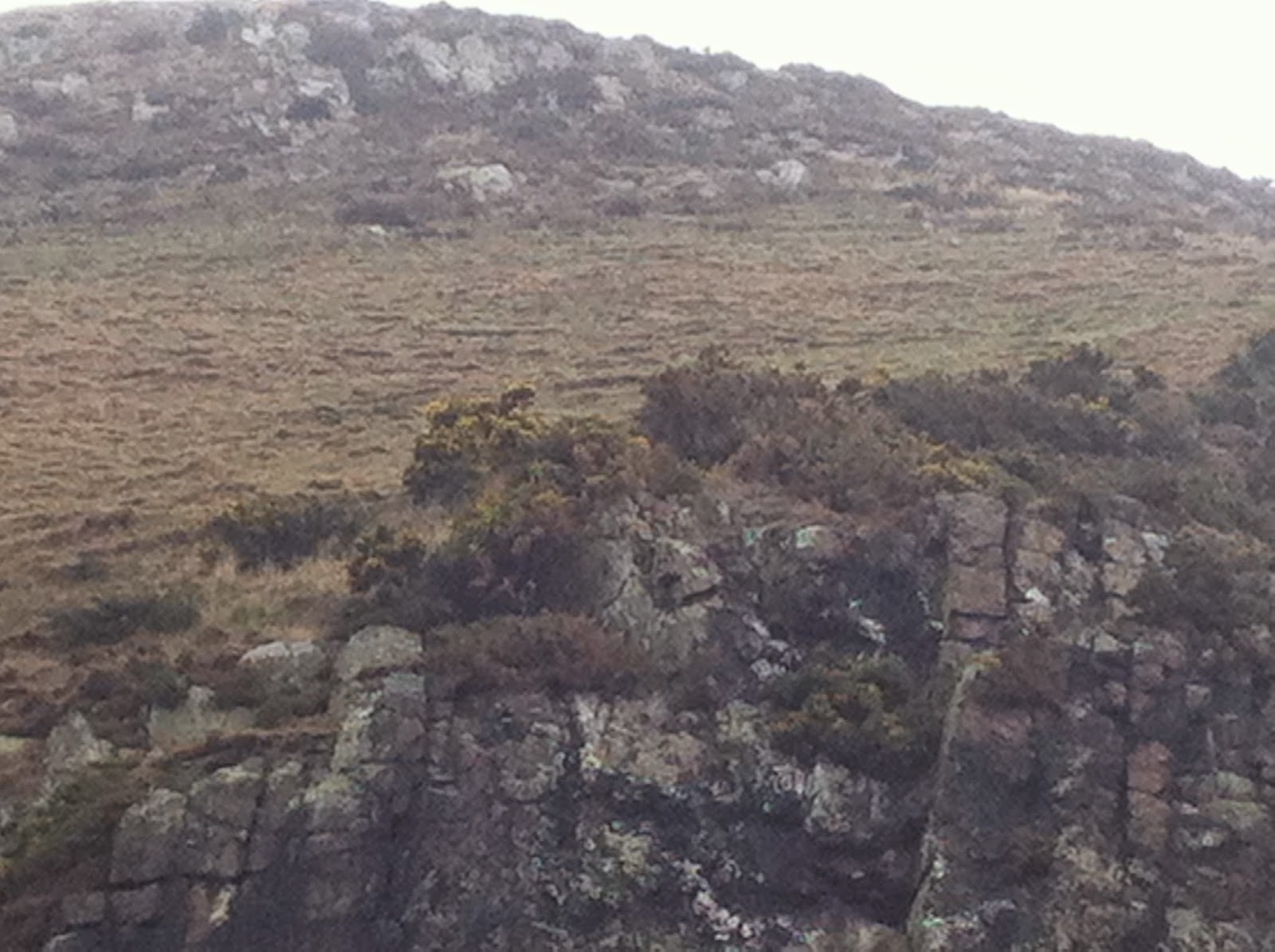
This old volcano helps define North Berwick's landscape, too.
Will there be opportunities to bring Nichols, Trollope, Olmsted and even Eliza Potter, a hairdresser of mixed race, who also traveled frequently, into conversation with one another next semester in "The Nineteenth Century City" course, which will be taught for a third time? Perhaps.
For sure, it's my hope to continue using Tuscaloosa as a "lab" to learn more about emerging urban life and the ways in which higher education figured into a modernizing America. Dr. Kapp gestured toward such an idea when he mentioned the desires of Israel Pickens, the third governor of Alabama, to make sure this state had an institution of higher learning after the state was founded in 1819.
We will see how it all goes.
I saw this pup playing with a new friend on the North Sea.
For now, it will be interesting to see ongoing efforts to document Alabama's bicentennial in the coming years. Tomorrow, many around Tuscaloosa will reflect on the 150th anniversary of the Union torching Tuscaloosa and UA buildings.
On another note, I was happy to see Katherine Richter, Executive Director, of the Tuscaloosa County Preservation Society, and Ian Crawford, Manager at Jemison Mansion at Kapp's talk. Richter and I have been discussing a possible project for the next iteration of "The Nineteenth Century City" course: focusing on the earliest schools for young women in Tuscaloosa. We shall see how that goes as well. For now, the countdown to this semester's end.
By the way, Crawford will be teaching a decorative arts course next fall. Do check out if you are looking for a new course. Consider "The Nineteenth Century City" as well.
Postscript: After writing this post, I thought about how the natural resources in Tuscaloosa and other parts of Alabama helped usher industry into this part of the country. What new stories can be told about modernity in the South with nature in mind? Also, how do we benefit from also addressing our country's complicated past? In addition to owning several plantations, Alabama Sen. Robert Jemison built bridges with Horace King, a former enslaved man who was a respected architect in the South.
Tomorrow around 4 pm, the students in this course will be live on the air at the University of Alabama's radio station, discussing the upcoming "world premiere" of their music video featuring music by Bible Study at 5:30 pm December 3 at Jemison Mansion (UA Art History Emeritus Dr. Robert Mellown will be our guest speaker). Check them out tomorrow if you can by visiting 90.7.
On other fronts...as the semester draws to a close, I thought I’d
take one last opportunity to share with you some of the thoughts of the students
enrolled in this class. While we are still concerned with emerging urban life
in America during the nineteenth century, I have challenged them to see how
some of the issues we’ve addressed have across-time resonances.
During two class meetings in the past two weeks, I did as much by asking them to look
at two motion pictures. One is the 2013 documentary Muscle Shoals, which explores all of the great music that came out
of one Alabama town as white and black bodies came together in a music studio,
particularly during the late 1960s and early 1970s. I’d earlier invited them to
see the 1991 film The Commitmentsas a means of continuing to explore the
cross-fertilization of music and cultures, but this time with working class
white Dublin, Ireland front and center. But given that we had just ended Martha Sandweiss’ study on
Clarence King, a nineteenth century geologist who is best known for having
mapped the West for the U.S. government than for having passed as “black” in
order to marry an African American woman after the Civil War, I figured it
might be worthwhile (and risky) to pick another film, maybe one that pushed us
to think about nationality, urban life, labor and race, but also secrets.
The students took took the bait and watched the 1996 motion
picture Secrets & Lies, which
concerns a black British professional woman’s discovery that her birth mom, a factory worker, who had earlier
given her up for adoption was white. In
this case, London was in the backdrop. Her half-sister, also white, is a street sweeper.
Regarding all three movies, I was quite concerned about how
the “city” functions in terms of how certain bodies come together and part and
how ideas about nationality and race and even gender can teach us something we
hadn’t thought about it earlier when we were solely concentrated on urban life
in America before the turn of the century.
No matter the
quality of their participation, or whether they participated at all, I want to
thank the students for being open to this exercise, which is the sort that
might be more fitting for a graduate class. I think they did pretty good. See
excerpts from their short reflections on the “History and Hollywood” hand-out
below (I want to thank my colleague Jimmy Mixson for sharing all of these
prompts, which he uses in his course on medieval history).
While continuing to think deeply about the urban
space in a maturing America, they were pushed to consider how a movie captures via story lines music, lighting, setting,
costume, dialogues some of the things we’ve discussed including urbanization,
women in public spaces in an urbanizing world, class and racial politics. Here are
excerpts from the students’ replies to Secrets
& Lies:
Caroline: In Secrets
& Lies, the role and struggles of women can be seen through the
different narratives. One woman struggles to enjoy her mundane housework;
another woman experiences personal shame of coming face to face with her decision
to give up her child for adoption; one woman is shocked at the realization that
her birth mother is in fact white; and another young woman with “unladylike”
manners [is a street sweeper] and doesn’t have much motivation to broader her
horizons.
This movie’s plot correlates well with Clarence King’s story. It
shows that it is in fact not unusual to have a white or black relatives without
physically looking like it...Class differences can be
seen in this film [and Muscle Shoals].In Muscle Shoals, it is seen
with successful city people come to a simple rural part of Alabama. In Secrets & Lies, it is seen in the
different professions of the newly discovered sisters. While one sister is an
optometrist, another is a [street sweeper]. Similarities between the mother of
the two sister and Clarence King can be made. The mother had a dark past that
she probably tried to hide from her family and King deceived Ada Copeland every
day …in order to keep themboth safe.
Wayne: The mother [who gave away her child years earlier]
lives in a lower class area of London….Her brother doesn’t visit often because
his wife doesn’t like [his sister]…The [entire family] has issues….The only one
who was able to face the consequences of their decision was the adopted
child. The racial and social separation within one family all draw them
together towards the end.
Voni : Shelter is a common way in which we see city values
emerge. [It] narrates who can afford certain luxuries.
Devon: The lighting [in Secrets & Lies] is kind of dark,
but I think that is because of English weather.
Jasmine: When the [social worker] asked the mixed [race]
woman about her childhood, I felt like she [revealed] the fact that she was [in
fact] mixed and how she [herself] felt about it.
Here are the students’ replies to Muscle Shoals:
Rae: I grew up mere miles ...from Muscle Shoals. I think we always expect[ed] this deep cultural/musical development from this area. I would love to know what influenced the great musicians to produce this music. Was it because of rural influences that so greatly differed from the rural space?... The [music]
studio [has resonances with] the drive that we see in people in the urban space. This drive
to develop something, to succeed, to survive and to be something different.
This movie truly gives us a look at what the “common humanity” that music has …for
an entire generation of artists. Music that flowed from Muscle Shoals was able
to transcend race and class in the 60s and 70s in Alabama and the world…The
filmmaker juxtaposed a vivid rural panorama with short clips of industry,
transportation, technology and natural resources. [These things] helped drive
urbanization in the nineteenth century and was influencing an area [that was]
not so urban.
Caroline: In Muscle
Shoals, many aspects of urbanization were depicted. We get to see how women
in public, especially strong women like Etta James and Aretha Franklin, was
more widely accepted and even admired [unlike in the nineteenth century]. These
women had a major impact on the music industry…The relationships between the
black and white musicians [was an] incredible improvement [from the past]. The
artists didn’t let the struggle between their races get in the way of what they
were trying to make…The filmmakers were very deliberate with their portrayals
of Muscle Shoals. After a big name artist or producer would talk about their
incredible soul and magic in the town, the filmmaker [chose] to depict the
stillness and natural beauty of Muscle Shoals. I think this was done to display
how ironic it must have been to those performers that a place like this could
create such a phenomenon.
Jeff: The music that came from...Muscle Shoals [was] some of the greatest hits [and] should forever be considered some of the greatest music because it came from the heart....It was music that moved...millions around the world.
Wayne: The movie notes how soulful rivers seem to develop near rivers and "seems to come out of the mud." Musically, the film uses long, sorrowful guitar chords and also folk style music during interviews. Yet, the music highlighted in the film is funk, rock 'n roll and soul music. The rock 'n roll and soul music played an important role in urban areas because it allowed people from different ethnic and cultural backgrounds to develop a sense of unity [as they] became interested in new music. However, the music that helped urban [people] was produced in an area with high racial tension and by men who considered themselves to be "country folk."
Devon: The people who wanted to recordor play with the band from Muscle Shoals all
expected them to be black. Everyone seemed to think that only certain types of
people could play that type of music. However, everyone who worked there did
so because of their passion for music.
Ben: I wished the film discussed what happened to Muscle
Shoals as a music hub as not many hits come from it anymore. Was there an event
or simply the change [in] popular culture away from funk and soul [that contributed to the decline]?
Jasmine: The scene showing the large bridges and dams as
well as the big power plant and train shows urbanization in Muscle Shoals.
Finally, the students were also asked to share the unanswered questions that
a particular film left them with and tell me whether they think film is an
appropriate medium for teaching history (This issue is extremely important to me. I noticed when I used 1940s and 1950s films about America and even Europe's urban and frontier past in last year's class, the students with few exceptions - such as the time I showed Bend of the River starring James Stewart and Rock Hudson or Little Old New York starring Alice Daye - seemed bored. This time, more of them paid more attention as I cautiously used more recent films as teaching tools).
On the issue of whether film is an appropriate medium for teaching
history, here's what some of them had to say:
Ben: I’d say [film] is a very good tool for anything from
American history, music history or cultural history.
Emily: Films are never perfect. They don’t always apply perfectly
to a lesson. They sometimes strive from accuracy for a good story.
Voni: Film allows for
a more interactive way of learning especially for visual learners. The
disadvantages of film, like any media, that the creator has an objective they
are trying to portray so we must extract the history from that.
Undre: Film produces a teaching experience that can be
interactive. This interactive lesson could come from pausing the video and
discussing how it relates to the topic of the class. Disadvantages of using
film could be that lesson valuable to the curriculum are over-kill [for] students paying attention to the wrong
elements of the movie. Another disadvantage can come from using non-biased
films to teach a biased lesson.
Jasmine: The film [Muscle Shoals] is great for showing the
emerging urban life in Alabama. It is a virtual time line not only covering
music, but it also covers what is going on in the world outside of music (for example, the
clip about Martin Luther King Jr. and clips of the segregation at the
University of Alabama).
Wayne: I am a visual learner. I enjoy seeing images of
urban areas and visually seeing personal expressions of racial and cultural
situations....Muscle Shoals [in particular] is very useful as a medium for teaching history.
Its advantages are that it is able to [present] American life outside
the studio while also providing entertaining songs that most can sing
along to...[The music] studio presented was a great example of the great
[things] that can happen when open-mindness is allowed.
Rae: Film does a great job of illustrating history in a way textbooks can't. However, film can skew history or present it very one-sided.
Jeff: [Film] is [an] appropriate medium because it is...entertaining. [But] sometimes it doesn't portray the entire history; just what [the filmmakers] want to show us.
Five students and I as well as Dr. John Beeler attended the Tuscaloosa County Preservation Society's Annual Award Banquet last night. Dr. Rachel Stephens of the University of Alabama's Department of Art and Art History and I were honored as Educators of the Year. Special thanks to Katherine Richter, Ian Crawford and Tim Higgins and so many others present for making us feel welcomed.
It was wonderful seeing A.J. Estep, a student in last year's class, join Emily Chadwell, Voni Cook, Will Jones and Ben Smith, four students from this year's class, at this event. Estep's classmates created the documentary "Tuscaloosa: The Nineteenth Century City" and this this year's students are making a music video. As true last year, Tuscaloosa is in the starring role.
My students know I readily admit that my interest in Tuscaloosa's role in emerging urban life is best pursued with them by my side as the trailer for the class's music video, which is presented in this posting, demonstrates. See the students "discovering" Tuscaloosa's landscape and pushing their thinking about this city's urban and rural past and present - and their own. The music video features the music of Bible Study, a local band. It premieres at 5:30 December 3 at Jemison Mansion, 1305 Greensboro Avenue in Tuscaloosa. Light snacks and beverages and a student art exhibition will be followed by a Q & A.
Tomorrow we will continue exploring Clarence King's life and that of his wife Ada Copeland King in New York City during the Gilded Age. King was a geologist for the U.S. Geological Society who "passed" as an African American in order to marry a woman who was a born enslaved. I am greatly interested in how the students are able to insert King and his wife into the story of emerging urban life. It is worth it, too, to think about King's interest in "slumming," (i.e. visiting African American neighborhoods; in his case lower Manhattan).
His quiet excursions appears to be an across-time phenomenon. Certainly over the Fall Break I read with great interest a story in Vanity Fair about the American-born George Whitman who opened the famous Shakespeare and Company bookstore in Paris in 1951. Prominent members of the Harlem Renaissance and the Beat Generation were among the writers who frequented the shop, which is now run by his daughter.
As it turns out - according to the article at any rate - Whitman was born in New Jersey in 1913 and raised in Salem, Massachusetts. He spent four years trekking around North and South America (King might have been his nineteenth century counterpart up to a point). His curiosity about the world around him and perhaps those who are quite different from himself manifests in his interest in "urban back alleys." He shares such a desire not only with King, but with Carl Van Vechten, a white photographer-patron of the Harlem Renaissance. I think, too, about the women who appear in Carla Kaplan's recent study on 1920s Harlem (students in my graduate course will read excerpts from this book next Spring). Andy Warhol's friendship with Jean-Michel Basquiat also flirts in this direction.
At the risk of collapsing time too much, I have already asked the students to be curious about popular interest in black life and moreover, the ability of whites on both sides of the Atlantic to engage themselves in what generally surfaces as "black" music. As I asked them, what "work" does the "city" do in such encounters? Last week, I presented the 1991 Alan Parker film "The Commitments," which finds a white Irish band in Dublin playing 1960s R & B and the recently released documentary "Muscle Shoals," which unveils white musicians backing many African American greats in rural Alabama.
Muscle Shoals. Dublin. Harlem. Late nineteenth century and postwar race, class and gender dynamics. Let's come to class tomorrow ready to pull these connections apart, and if we are lucky, make some time to watch a bit of one or both movies. Thank you, Librarian Brett Spencer, of UA's Gorgas Library, who will soon be leaving for Penn State, for always ordering films and videos for this course and other courses. The History Department will miss you!
We presented our short film, "Tuscaloosa, The Nineteenth Century City" today. Katherine Richter, Executive Director of the Tuscaloosa County Preservation Society and University of Alabama graduate, spoke after the film was shown. You may see the entire short here. Enjoy.
Here is a sound clip of me and the students trying to read the script for the short "Tuscaloosa, The Nineteenth Century City." While you listen, check out this Bama sunset. As my colleague Bart Elmore edits the music and I edit the photography for this short, I look forward to seeing the students' final papers on an existing Tuscaloosa building that was built during the nineteenth century. The short will be shown at 4 pm, December 4, in Room 118, tenHoor Hall. In the meantime, Roll Tide!
Pictured here are two photos of the Van Antwerp building in Mobile, Alabama. Just 11 stories high, the building was completed in 1907 and was considered the city's first skyscraper. The building, which has lovely details, is currently being renovated. My husband and I once ate in the restaurant on its first floor. In it, one can see signs of a pharmacy that once occupied the place. Back in the day, professionals revealed their clout if they had an office in this building. I am thinking of using these images in a "Meet the Students" video, which will be shortly visible on this site. As the students will learn in Gunther Barth's City People, the first text before us, by the time this building was constructed many Americans were already fleeing the decay seen in cities. The affordability of automobiles in the early 20th century made it possible for many individuals to move to less congested areas. The tensions between the city and quieter places that might be described as either the suburbs or the countryside are always before us. For example, during this class's first meeting this past Wednesday, we introduced ourselves by announcing our names, where we were from and whether we thought our birthplace could be described best as the city or country. Depending on how we answered, we then had to name something "uncountry" or "uncity" about ourselves. It was interesting to hear how we dealt with stereotypes concerning either space. As we continue probing such ideas, we are witnessing enthusiastic
Detail of Van Antwerp building, Mobile, AL
interest and support from many among them, Professor Jeremy Butler from UA's College of Communication & Information Sciences; Telecommunication & Film, who made me aware of a Library Congress link featuring archival photos of nineteenth century Tuscaloosa buildings. As mentioned in a previous blog entry, UA Research Librarian Brett Spencer kindly added this link on a digital Library Guide to which the students have access. In addition to Dr. Richard Megraw, who, as also mentioned, will share his expertise on the linkages between baseball and nineteenth century American cities, as a guest speaker, Sarah Riches, who has a Masters in Architecture, will also join us as a guest speaker. Riches will help the students understand how old buildings have stories to tell. Susan Reynolds, Associate Editor of Alabama Heritage, another guest speaker, will share her memories of working in the Kilgore House, which was recently demolished. Next week, Emily Jamison of UA's Special Events will give the students a tour of the President's Mansion. That same day, the students will visit Hoole Library where postdoctoral fellow Dr. Amy Chen will introduce them to resources that will help them complete their first essay on a local building. Ian Crawford, House Manager of the Jemison Mansion, has also offered to aid the students with their research and invited them to tour that mansion. We look forward to sharing what we learn along the way. Stay tuned.
I am still plotting out the various lessons that will be taught in this course. There is one thing on the horizon that I am especially excited about as a newcomer to the state of Alabama. If all goes as planned, the students and I will travel to Birmingham to tour Sloss Furnaces, a national historic landmark. I believe this site will help us understand how industry and technology played a role in America's emerging city life during the nineteenth century. While the original Sloss complex is no longer standing, two 400-ton blast furnaces and some forty other buildings in this complex will aid our ability to think deeply about many issues concerning modern life in the late nineteenth and early twentieth centuries. We will, among other things, learn about Sloss's role in putting Birmingham on the map as an important American city. As an aside, just as I used a blog while teaching "African Americans in the City" last spring at the University of Alabama during a graduate fellowship, I will use a blog for this course. Please check it regularly to learn more about the issues being discussed in this class.

 The end of the semester is quickly approaching. The students enrolled my "The Nineteenth Century City" course have completed the work for our December 2 presentation. There, we will present our research on young women and education in early Alabama and an urbanizing America. Between the 1830s and 1920, cities increasingly grew in the United States owing partly to the invention of the steamboat and railroads, two technologies that helped people move through space more easily. Historian Gunther Barth has argued that within this period an urban “culture” emerged via the arrival of apartment houses, department stores, baseball, vaudeville houses, and metropolitan newspapers. In such things, as he writes, people with very different racial and ethnic backgrounds managed to find a “common humanity” and learned how to cope in congested spaces. Notably, Barth did not look to churches or institutions of higher learning for signs of an urbanizing America. This was possibly because in those two spaces he saw more homogeneous populations, or people whose backgrounds were similar. The students in this course were charged with looking for signs of an urban culture in the lives of young women who attended college during the nineteenth century or at the turn of the century, in and outside of Alabama. Certainly a female academy existed in Tuscaloosa even before the University of Alabama opened in Tuscaloosa in 1831. Some such students include Addie Lovett Findlay whose diploma is pictured here, and the coeds who lived with the family of a Bryce Hospital administrator. They are also pictured. As this exhibit hopes to demonstrate, young women in a city that still feels like a college town even today were becoming sophisticated people in the years surrounding the Civil War. The students studied several documents to learn more about such women and others in West and North Alabama. Among the documents was an 1861 letter from a Huntsville, Alabama, girl of mixed race who attended Wilberforce after being recently manumitted. Ultimately, the class saw how historians interpret the past while often relying on very little information. The result was four displays that will be presented on 4-5:30 pm at the university's Gorgas House. Use this interactive map for directions. There will also be a silent auction of photography inspired by the nineteenth century city theme taken and curated by the students. We are pleased to have Birmingham Southern University Associate Professor of History Victoria Ott as our guest speaker. Her talk is titled "A Safe Place to Hide?: The Role of Female Academies in the Confederate South."
This event is co-sponsored by the Summersell Center for the Study of the South.
The end of the semester is quickly approaching. The students enrolled my "The Nineteenth Century City" course have completed the work for our December 2 presentation. There, we will present our research on young women and education in early Alabama and an urbanizing America. Between the 1830s and 1920, cities increasingly grew in the United States owing partly to the invention of the steamboat and railroads, two technologies that helped people move through space more easily. Historian Gunther Barth has argued that within this period an urban “culture” emerged via the arrival of apartment houses, department stores, baseball, vaudeville houses, and metropolitan newspapers. In such things, as he writes, people with very different racial and ethnic backgrounds managed to find a “common humanity” and learned how to cope in congested spaces. Notably, Barth did not look to churches or institutions of higher learning for signs of an urbanizing America. This was possibly because in those two spaces he saw more homogeneous populations, or people whose backgrounds were similar. The students in this course were charged with looking for signs of an urban culture in the lives of young women who attended college during the nineteenth century or at the turn of the century, in and outside of Alabama. Certainly a female academy existed in Tuscaloosa even before the University of Alabama opened in Tuscaloosa in 1831. Some such students include Addie Lovett Findlay whose diploma is pictured here, and the coeds who lived with the family of a Bryce Hospital administrator. They are also pictured. As this exhibit hopes to demonstrate, young women in a city that still feels like a college town even today were becoming sophisticated people in the years surrounding the Civil War. The students studied several documents to learn more about such women and others in West and North Alabama. Among the documents was an 1861 letter from a Huntsville, Alabama, girl of mixed race who attended Wilberforce after being recently manumitted. Ultimately, the class saw how historians interpret the past while often relying on very little information. The result was four displays that will be presented on 4-5:30 pm at the university's Gorgas House. Use this interactive map for directions. There will also be a silent auction of photography inspired by the nineteenth century city theme taken and curated by the students. We are pleased to have Birmingham Southern University Associate Professor of History Victoria Ott as our guest speaker. Her talk is titled "A Safe Place to Hide?: The Role of Female Academies in the Confederate South."
This event is co-sponsored by the Summersell Center for the Study of the South.




.JPG)


